Life today moves with the restless rhythm of urgency — emails at midnight, overloaded calendars, minds constantly occupied with the next deadline or digital notification. Amid this relentless hum of activity, many seek peace only to discover that stillness is not easily found. The mind, once set into motion, resists quiet. It becomes a storm of thoughts — loud, restless, and unyielding Yoga Class .
But what if peace wasn’t found by escaping the storm, but by dancing through it — letting the chaos become a path to clarity?
This is where the yoga journey from Ashtanga to Yoga Nidra begins — a sacred arc of transformation that channels the turbulence of the body and mind into radiant stillness. It’s a journey of movement into stillness, effort into ease, doing into being.
The Inner Compass: Why We Begin
Before stepping onto a mat, the most essential movement happens within — when you decide to realign. Every yoga class, every breath, every sequence begins with a whisper: I am ready to return to myself.
Yoga Class Many of us come to yoga seeking physical strength or stress relief, but the deeper reason is always subtler — a longing to rediscover inner harmony. The bridge that connects chaos and clarity is not built overnight. It’s tread breath by breath, pose by pose, awareness by awareness.
This journey unfolds in two parts:
- Ashtanga Yoga — a fire-filled, physically demanding path that burns away layers of stagnation and mental turbulence through rhythmic sequence and conscious breath.
- Yoga Nidra — the art of conscious relaxation and trance-like surrender where awareness deepens beyond the waking, dreaming, and sleeping mind.
Together, they offer a complete alchemical process — one that purifies, harmonizes, and integrates body, mind, and spirit.
Part I: The Fire of Discipline — Ashtanga Yoga
Ashtanga means “eight limbs,” derived from the ancient teachings of Maharishi Patanjali’s Yoga Sutras. It’s more than just a physical practice; it’s a spiritual discipline designed to forge profound inner transformation.
The Flow of Breath: Vinyasa as Sacred Movement
In a traditional Ashtanga class, every movement follows the breath — this is Vinyasa. The practitioner learns that breath is the link between body and consciousness. With every inhale, the body expands; with every exhale, it releases.
The Ujjayi pranayama — the “victorious breath” — is the steady wind that guides the Ashtanga sequence. Softly audible, resonating in the throat, it mirrors the sound of ocean waves. It doesn’t just oxygenate; it focuses the mind, anchoring awareness to the present.
When breath and movement merge, the scattered energies of the mind begin to consolidate. What starts as chaos — thoughts racing, distractions rising — slowly settles into rhythm.
This synchronicity is the first step toward clarity.
The Journey Through the Series
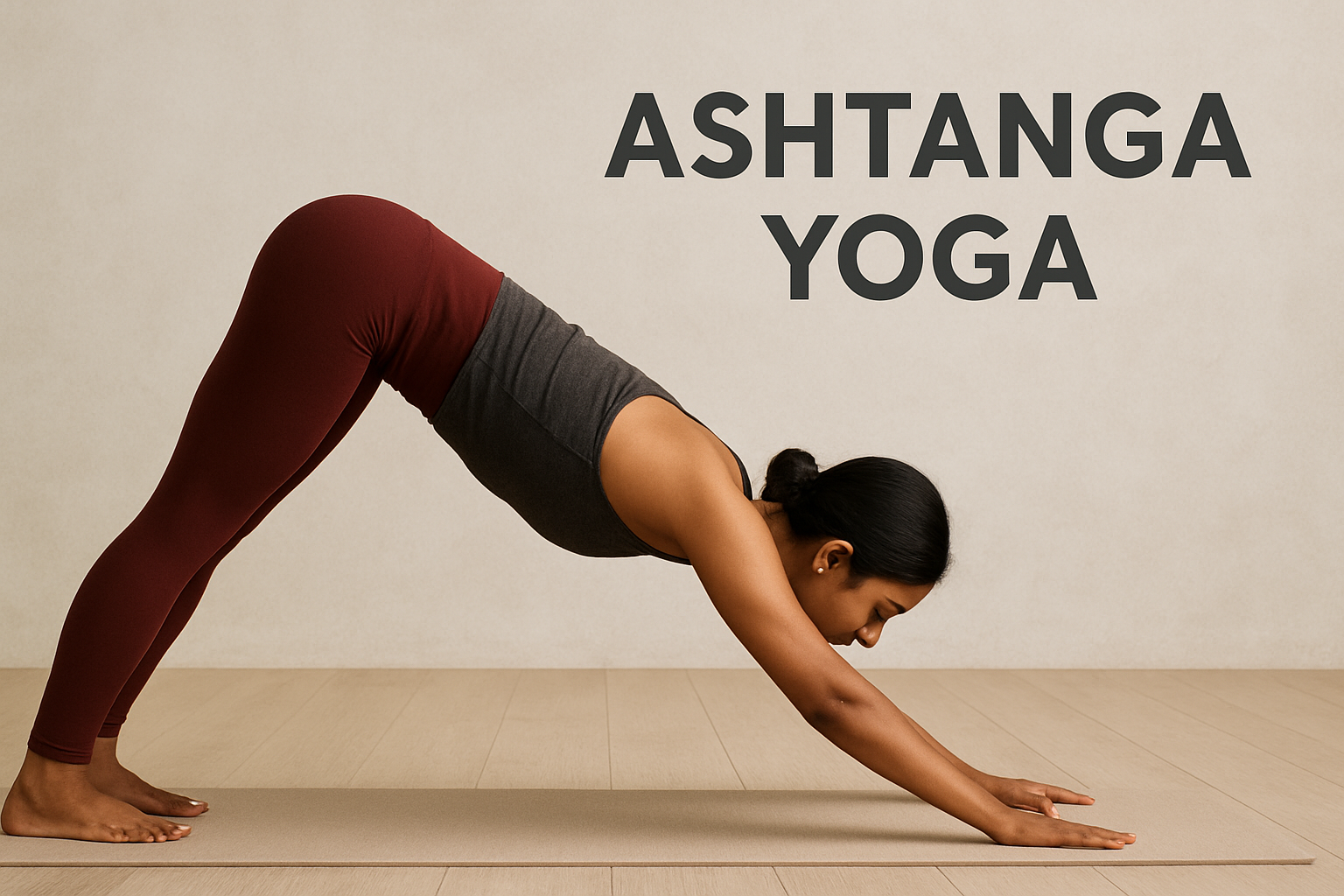
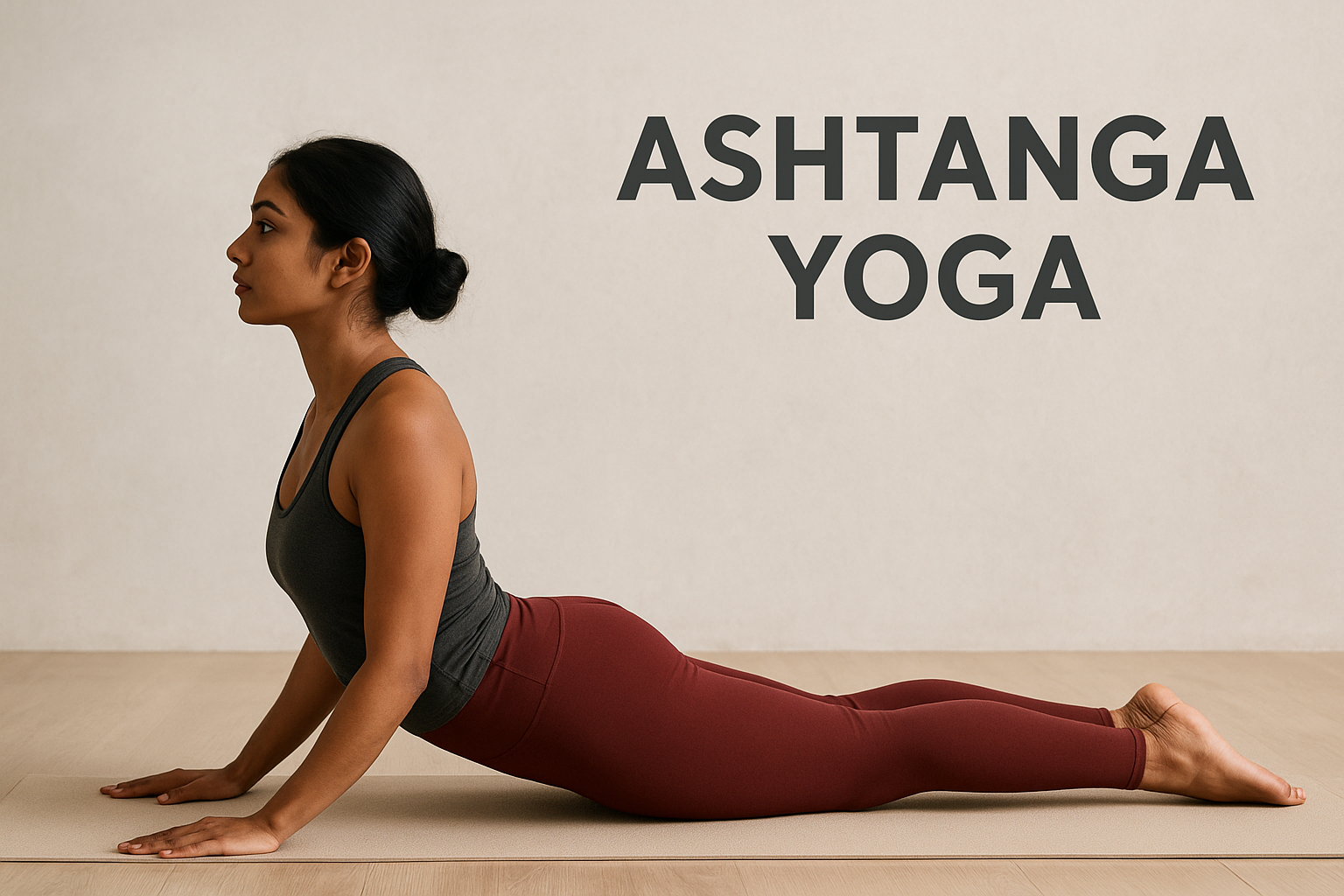
A typical Ashtanga class begins with Surya Namaskara (Sun Salutations) — a dynamic ritual of awakening. The repetitive bowing to the sun dissolves habitual stiffness — physical and mental — energizing the body and igniting the inner fire (Agni).
Each series, from Primary to Advanced, unfolds like a map of consciousness:
- Primary Series (Yoga Chikitsa) — “Yoga Therapy.” It detoxifies and realigns the body.
- Intermediate Series (Nadi Shodhana) — “Cleansing of the Energy Channels.” It moves deeper into the energetic and emotional layers.
- Advanced Series (Sthira Bhaga) — “Steadfast Strength.” It cultivates the balance of strength and grace, effort and surrender.
The purpose is not to master the postures but to use them as mirrors reflecting our current state — revealing impatience, ego, resistance, or fear.

The Sacred Triad: Breath, Bandha, and Drishti
Every Ashtanga sequence rests on three pillars:
- Breath (Pranayama): The steady, rhythmic flow that unites movement and presence.
- Bandha (Internal Locks): The energetic seals — Mula Bandha (root lock), Uddiyana Bandha (abdominal lock), and Jalandhara Bandha (throat lock) — channel prana (life force) upward, awakening subtle awareness.
- Drishti (Gaze Point): The focused gaze that steadies the wandering mind and trains internal concentration.
Together, they transform asana from mere exercise into moving meditation.
From Fire to Flow: The Inner Alchemy
At first, Ashtanga feels like an intense physical challenge. Muscles tremble, breath shortens, mind resists. Yet, when practiced consistently and consciously, something miraculous occurs: the fire that once burned becomes purifying.
- The trembling becomes strength.
- The resistance becomes release.
- The breath becomes rhythm.
- The movement becomes stillness in motion.
This is Tapas, one of the Niyamas — the heat of disciplined practice that burns impurities and refines awareness.
Through Tapas, the practitioner no longer runs from discomfort but moves through it with grace. The inner chaos — whether emotional, mental, or energetic — is not suppressed but transmuted.
Ashtanga as Meditation in Motion
In Ashtanga, each asana is a mantra expressed through the body. The repetition, sequence, and discipline shift awareness inward. The sweat, the effort, the synchronized breath — they all culminate in moments of pure silence between inhalation and exhalation.
The conscious movement clears the noise so that awareness can begin to listen — deeply.
This is where the deeper work begins.
When the body becomes still after the final Savasana, what remains is raw presence — open, awake, receptive.
And here, the practitioner is ready to enter the next phase of the journey: Yoga Nidra — the path of effortless awareness.
Part II: The River of Stillness — Yoga Nidra
If Ashtanga is the fire that burns away chaos, Yoga Nidra is the cool river that carries you into clarity. Often called Yogic Sleep, it is a systematic meditative technique that invokes profound relaxation while maintaining sharp awareness.
It is not mere rest. It’s an inner pilgrimage — a conscious descent from the outer layers of the personality (body, senses, and mind) to the quiet, unchanging core of being.
Understanding the Science of Yoga Nidra
Unlike conventional sleep, in Yoga Nidra the practitioner hovers between wakefulness and dreaming. Brain wave patterns slow down from beta (high alertness) to alpha (relaxed), then theta (creativity and intuition), and finally delta (deep, restorative rest).
Physiologically, it brings the nervous system into harmony, balancing sympathetic and parasympathetic responses.
Energetically, it awakens pratyahara — sensory withdrawal — that leads toward deeper states of meditation.
The process dissolves accumulated tension from all levels — muscular, emotional, and mental — allowing true regeneration to occur.
The Layers of Self: Journey Through the Koshas
Yoga Nidra beautifully mirrors the philosophy of the five Koshas — the sheaths that veil our consciousness.
- Annamaya Kosha (Physical Body): Awareness begins by sensing the body’s form, texture, and weight. Grounding starts here.
- Pranamaya Kosha (Energy Body): Breath awareness gently expands life force through each cell.
- Manomaya Kosha (Mind Layer): Thoughts observed without judgment begin to slow and quiet.
- Vijnanamaya Kosha (Wisdom Body): Insight and discernment awaken, revealing inner truths.
- Anandamaya Kosha (Bliss Body): A luminous silence arises — peace that feels boundless and intimate all at once.
Each stage brings a soft shedding until you touch what has always been there — clarity unshaken by chaos.
The Role of Sankalpa: The Seed of Transformation
At the heart of every Yoga Nidra practice is Sankalpa — a heartfelt intention or resolve. Unlike fleeting affirmations, a Sankalpa emerges from the intuition of your higher self.
It might be as simple as:
I am whole.
I live with ease.
My awareness is pure and steady.
The Sankalpa is planted in the fertile soil of the subconscious when the mind is deeply relaxed but alert. Just as a seed knows how to become a tree, your Sankalpa begins to shape inner and outer transformation naturally.
The Method: A Typical Yoga Nidra Session
A well-guided Yoga Nidra class often unfolds in stages:
- Settling into Stillness: The practitioner lies in Savasana (corpse pose), surrendering body weight to the earth.
- Sankalpa Setting: The resolve is stated mentally with sincerity and calm conviction.
- Body Rotation of Consciousness: Attention moves systematically through body parts, training awareness to stay detached yet observant.
- Breath Awareness: Conscious observation of natural breathing induces deeper relaxation.
- Visualization and Energetic Awareness: Guided imagery dissolves subconscious tension, allowing integration.
- Sankalpa Reaffirmation: The intention is restated, now fortified by subconscious harmony.
- Gradual Reawakening: Awareness expands outward; the practitioner returns renewed, peaceful, clear.
The Bridge Between Effort and Ease
After the fiery discipline of Ashtanga, Yoga Nidra feels like the tender afterglow. The body, now purified and open, becomes a vessel of receptivity. The pranic channels are balanced, and the mind—exhausted of distractions—can finally surrender.
Here, effort ceases.
All the striving dissolves.
You simply rest in awareness itself.
This is where clarity emerges — not as something achieved but as something revealed. It was always there, hidden beneath the noise.
Part III: The Integration — From Practice to Life
The synergy between Ashtanga and Yoga Nidra mirrors the essential balance of existence: Shakti and Shiva, movement and stillness, effort and surrender.
In practice, Ashtanga burns away the fog of inertia; Yoga Nidra restores the harmony of being. Together, they complete the cycle of transformation.
Healing the Nervous System
This integrated approach recalibrates the entire nervous system. The Ashtanga sequences stimulate sympathetic activation — energy, heat, circulation. Yoga Nidra then guides the body into parasympathetic dominance — healing, rest, digestion.
Such balance cultivates resilience, emotional stability, and mental lucidity — the roots of clarity.
Emotional Purification and Inner Release
During Ashtanga, emotional residue stored in muscles and fascia often surfaces. The intense physical focus brings hidden fears and frustrations into light.
Yoga Nidra, following this catharsis, acts as an emotional balm. The deep relaxation softens mental knots and allows the psyche to integrate what the body has released.
This cycle of activation and surrender works like emotional alchemy — the transformation of repressed energy into insight and peace.
Conscious Lifestyle Alignment
Practicing both also nourishes Svadhyaya (self-study) and Santosha (contentment), two limbs of Ashtanga philosophy. You begin noticing how clarity extends beyond the mat:
- You respond, not react.
- You communicate with greater presence.
- Your sleep deepens, digestion improves, focus sharpens.
- You sense beauty in stillness again.
This is yoga in its truest sense — union — harmony of inner and outer worlds.
The Spiritual Arc: From Doer to Witness
At its deepest level, the Ashtanga–Nidra fusion dissolves identification with “doing.” In Ashtanga, you move with mindful intention. In Nidra, you watch awareness itself.
Over time, the practitioner shifts from acting in awareness to abiding as awareness.
In that state, chaos, clarity, fatigue, energy — all become passing waves.
You remain the ocean — vast, unshaken, luminous.
Part IV: A Guided Journey — From Fire to Stillness
Imagine this class experience — a complete two-hour journey designed to take you from chaos to clarity.
Stage 1: Grounding in Breath (10 minutes)
You arrive — shoulders tight, thoughts scattered. The teacher invites you to close your eyes, bring awareness to your breath. The first few inhales feel shallow; exhalations, rushed. Gradually, rhythm emerges. The nervous system begins to soften. The outer noise fades.
This is the threshold — where awareness meets the body.
Stage 2: Igniting the Fire (45 minutes)
The class flows into Ashtanga Primary Series. Surya Namaskar A and B awaken cellular energy. The sweat glistens, mind wrestles, breath deepens.
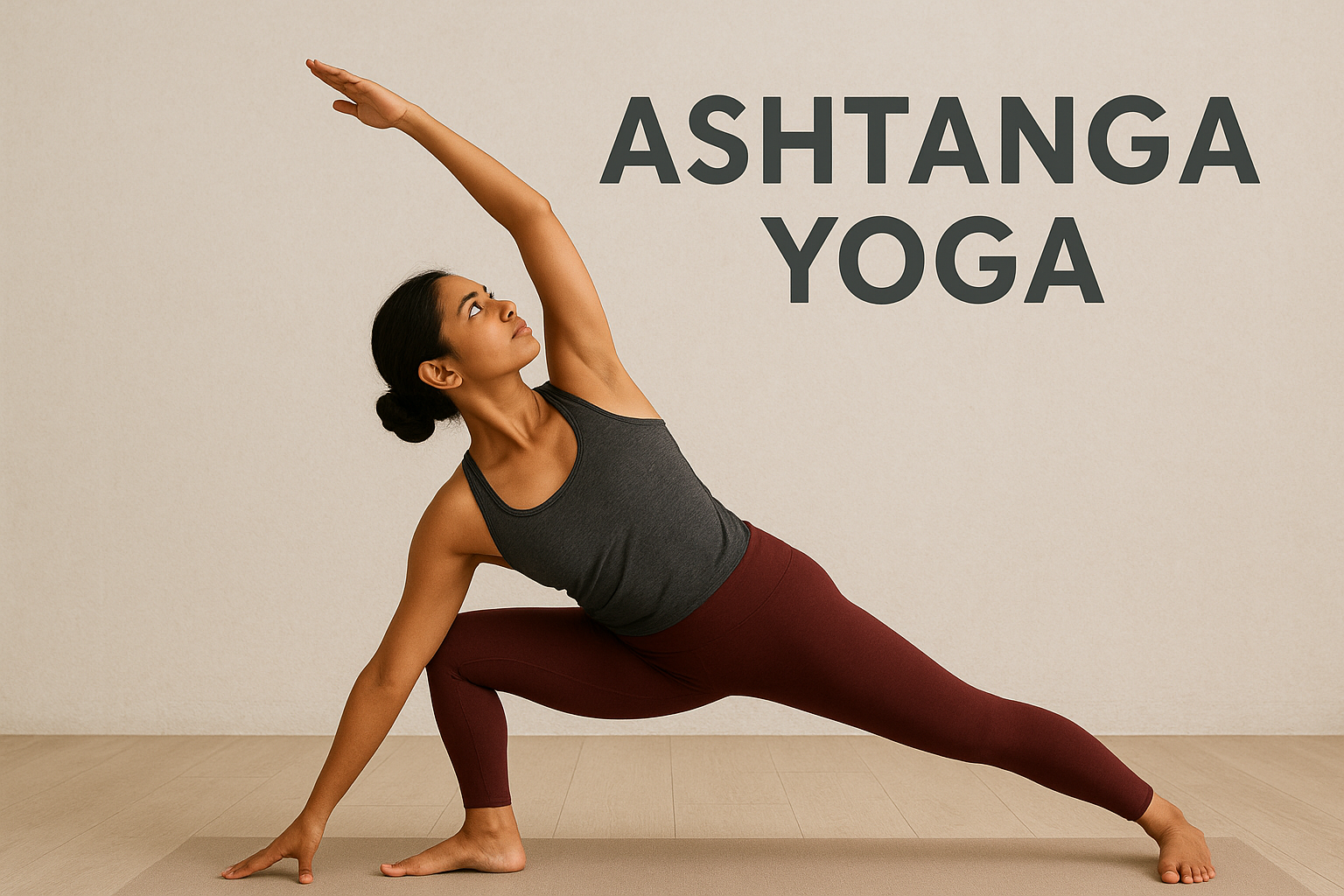
Each posture — Trikonasana, Parsvottanasana, Utthita Hasta Padangusthasana — becomes a dialogue between strength and surrender.
The teacher reminds:
“Find steadiness in breath, not in muscle.”
As the sequence unfolds, the scattered chaos of modern life transforms into single-pointed focus.
Heartbeats sync with Ujjayi rhythm.
Movement merges into a breathing mandala.
When the sequence ends, all that remains is silence — a silence alive with pulse and presence.
Stage 3: Surrender into Yoga Nidra (45 minutes)
Lying down in Savasana, still warm from the Ashtanga fire, the body yields to gravity. The breath softens. The teacher’s calm voice guides awareness through each limb.
You set your Sankalpa:
“I am peace itself.”
As awareness descends layer by layer, mind’s chatter dissolves. You hover between dreaming and waking, witnessing sensations as waves.
Images flicker, emotions settle.
Then — pure stillness.
In that stillness, clarity shines like dawn after storm.
Stage 4: Returning with Clarity (10 minutes)
The class ends with a gentle reawakening. You feel lighter, clearer, deeply rested. The body hums with vitality, the mind — calm yet alert. The world, still the same as when you entered, now feels different — more vivid, kinder, quieter.
You’ve moved from doing into being.
From chaos into clarity.
Part V: The Deeper Teaching — Yoga Beyond the Mat
The integration of Ashtanga and Yoga Nidra is not confined to a 90-minute class. It’s a reflection of how we can live in alignment.
- Morning: Embody movement and discipline — act decisively, create, serve.
- Evening: Embody stillness and surrender — reflect, release, rest consciously.
This rhythm honors the natural polarity of existence. Just as day complements night, action complements rest. Life’s clarity unfolds not from controlling chaos but from dancing gracefully within it.
Philosophical Insight: The Dance of Shiva and Shakti
In tantric philosophy, all creation arises from the union of Shiva (pure consciousness) and Shakti (dynamic energy).
Ashtanga embodies Shakti — vibrant, active, fiery.
Yoga Nidra embodies Shiva — silent, receptive, eternal.
Their union is yoga — the merging of awareness and energy.
When these forces unite within you, life stops being a struggle between extremes. It becomes an exquisite interplay — effort infused with grace, stillness alive with vitality.
Part VI: The Return to the Self
Ultimately, the journey from chaos to clarity is not about becoming someone new; it’s about remembering who you truly are beneath the turbulence.
Each breath in Ashtanga reminds you of your resilience.
Each still moment in Yoga Nidra reminds you of your wholeness.
Both lead you home — to the center of stillness that has always been untouched by the world’s noise.
In that sacred center lies the realization:
You were never lost. You were simply learning to listen.
Part VII: Practical Takeaways — Bringing the Journey Home
For those seeking to integrate this powerful Ashtanga–Yoga Nidra practice into everyday life, start with small, consistent steps:
- Morning Practice: 30 minutes of Ashtanga-based movement or breath-centered flow to awaken energy.
- Evening Practice: 20 minutes of Yoga Nidra, guided or self-paced, to release the day’s accumulation.
- Weekly Deep Session: One dedicated class combining both — fire and flow followed by complete surrender.
- Mindset: Approach each with reverence, not performance. Let the goal be clarity, not perfection.
- Integration Ritual: Journal after each session. Note not only physical sensations but emotional clarity and energetic shifts.
In time, the chaos of life no longer feels like an enemy. It becomes a teacher — reminding you to move, breathe, release, and rest in awareness.
Conclusion: The Eternal Pulse of Clarity
Ashtanga and Yoga Nidra are not polar opposites; they’re sequential rhythms of one sacred process — awakening. Ashtanga teaches you to inhabit the body with presence; Yoga Nidra teaches you to transcend it with awareness.
Between them unfolds yoga’s greatest secret:
You are both the stillness and the storm.
Through discipline and surrender, you discover that clarity is not born when chaos disappears — it blooms when you stop identifying with it.
Then life itself becomes meditation.
Every action is yoga. Every breath is prayer.
Every still moment is the homecoming of consciousness.
The journey from chaos to clarity is not a linear path that begins and ends on the yoga mat — it is a lifelong movement, a spiral of inner evolution. Each breath, each posture, each stillness is a reminder that transformation unfolds quietly, in layers. It does not demand perfection; it only asks for presence.
When you first begin practicing Ashtanga, you may find yourself wrestling with the fire — trembling limbs, restless thoughts, impatient expectations. Yet over time, that very heat